
“How long will my website take?” comes right after “how much will it cost” for most small business owners. You have a launch, an opening or a campaign in mind, and you want to know when the site will be ready for it. (If cost is the question you came in with, see what affects the cost of a website in Dubai.)
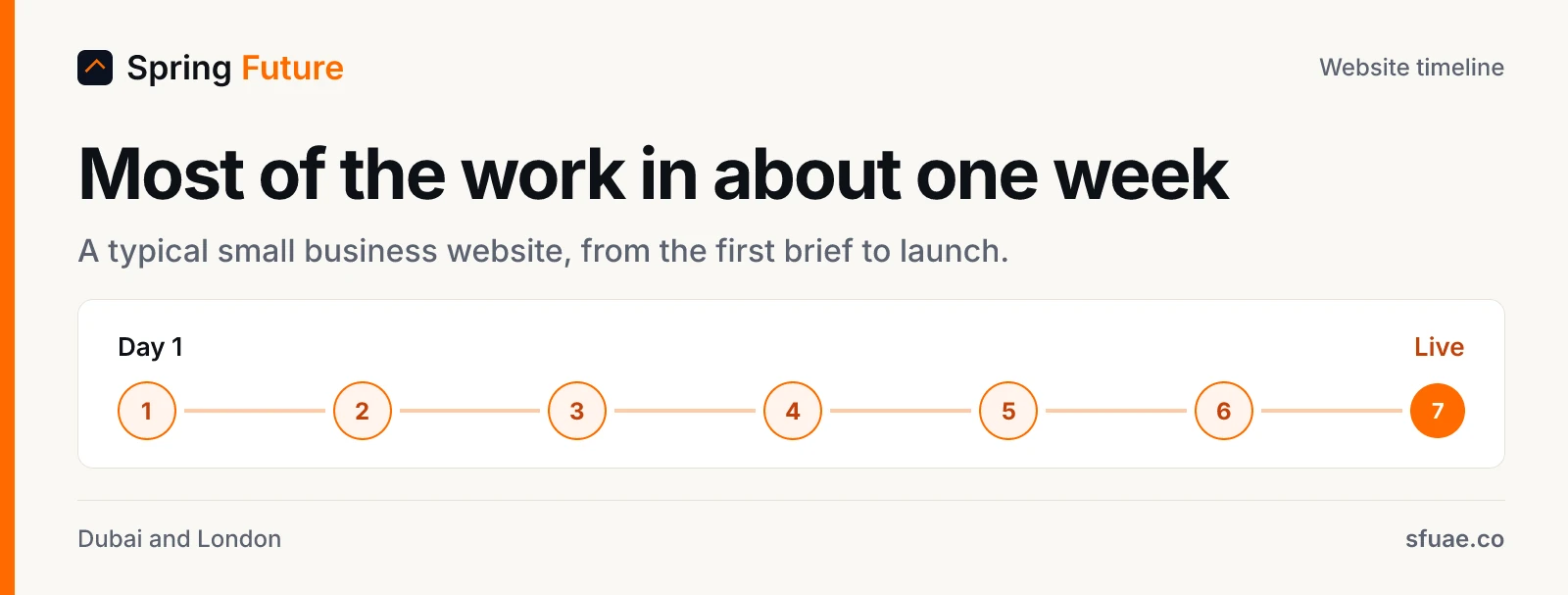
The good news is that a small business website does not have to take months. At Spring Future, most of the work on a typical project is done within about one week. This guide walks through a typical first week, how the timeline changes by type of site, what usually slows a project down, and what you can prepare so your website goes live sooner.
The short answer
For a typical small business website, the main part of the work is done in the first week: structure, design, text and the build. A very large project, such as one with many pages, several languages or a big product catalogue, has its main part finished in the first week, and the rest follows step by step.
The design and code are rarely what holds a website back. Waiting is. Waiting for a logo file, for photos, for an approval, or for access to a domain. When those are ready, a website moves quickly.
A typical first week, day by day
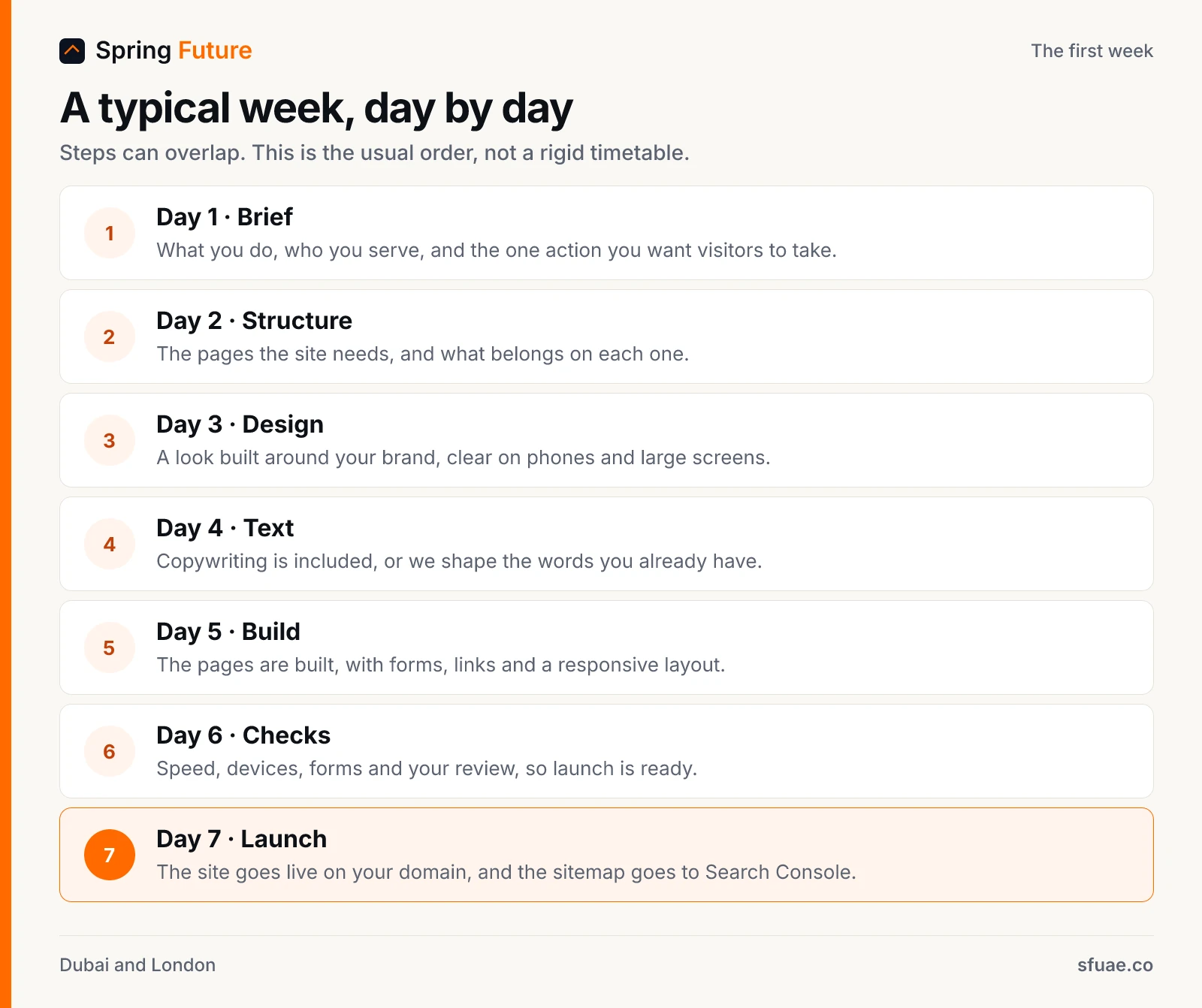
A clear process is what makes a short timeline possible. The days below are the usual order for a focused site. Steps often overlap — text can start while the design is taking shape, and checks run as pages are built — so this is a guide, not a rigid timetable.
| Day | What usually happens |
|---|---|
| Day 1 | A short brief: what your business does, who your customers are, and the one action you want visitors to take — call, send a message, book or buy. |
| Day 2 | Structure. Which pages the site needs and what goes on each one. For most small businesses that means a home page, service pages, an about page and a contact page. |
| Day 3 | Design. A look built around your brand and your customers, clear on phones as well as on large screens. Our guide to responsive web design explains why that matters. |
| Day 4 | Text. Copywriting is included at Spring Future when a page needs new words. You can also send your own text, and we shape it to fit the design. |
| Day 5 | Build. The pages are put together, with forms, links and a layout that works on different screen sizes. |
| Day 6 | Checks. The site is tested on different devices and reviewed for speed, forms and links. This is also when your feedback is folded in. |
| Day 7 | Launch. The site goes live on your domain, and we submit the sitemap to Google Search Console so Google can find the new pages. |
If the first version of the site is larger than a typical brochure or service website, the same first week still covers the main part. Extra pages, a second language or a large product list can follow immediately after, step by step, without starting the project again.
How the timeline changes by type of site
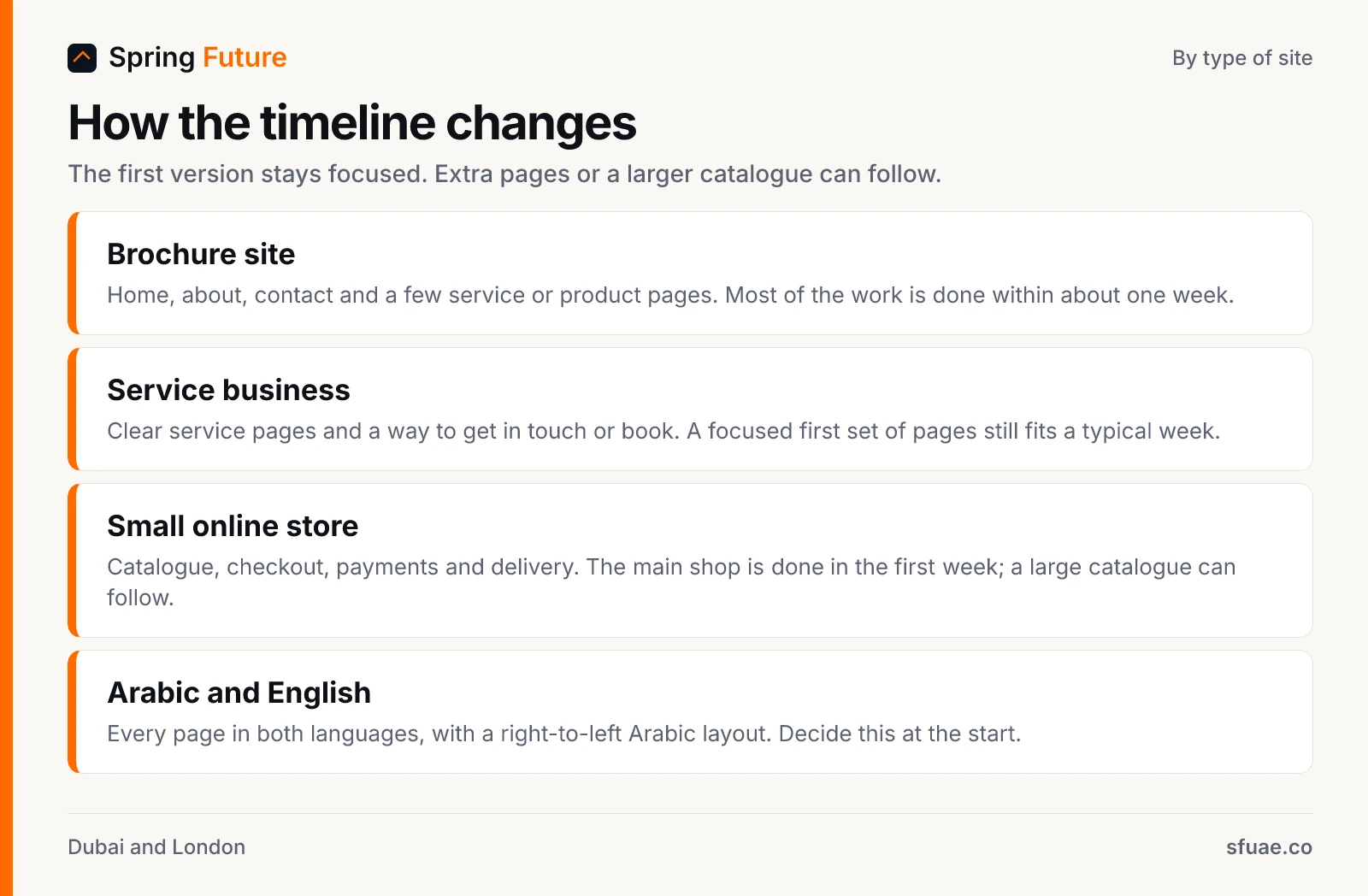
“How long does it take?” depends on what the first version of the site needs to do. A focused first version is what keeps the main work inside about one week. More can be added after launch.
| Type of site | What it usually includes | When the main work is done | What may follow |
|---|---|---|---|
| Brochure site | A home page, about page, contact page, and a few service or product pages that explain what you offer. | About one week. | Extra pages or a blog after launch, once the first site is live. |
| Service business | Clear service pages, a way to get in touch or book, and often a team or work page. | About one week, when the first set of pages is focused. | More locations, a longer list of services, or booking features as a next step. |
| Small online store | A catalogue, cart and checkout, a way to pay, and clear delivery rules. See online store development in Dubai and our comparison of Shopify and WooCommerce. | The main shop is done in the first week. | A large product import or extra connections to delivery or accounts, step by step. |
| Arabic and English | Every page in both languages, with a right-to-left Arabic layout for menus, icons and forms. | The main part is done in the first week. | On a larger site, the second language and its checks can follow step by step. |
If you plan to sell online, our guide on what shapes the cost of an e-commerce website in the UAE walks through the same decisions from the store side.
What decides how long your website takes
The number of pages
A focused site with a handful of pages is quicker than a site with dozens of service, location or blog pages. Each page needs a purpose, text and a design that fits. If you are not sure how many pages you need, start with the pages your customers really look for. More can be added later.
Who writes the text
Text is often the slowest part of a website when it waits for a quiet moment that never comes. Because copywriting is included in our work, this step does not have to wait for you. If you prefer to write it yourself, a draft on day one keeps the week moving.
Photos, logo and brand
A logo in a good file format, your brand colours and real photos of your team, place or products make the design faster and the result more personal. If you do not have photos yet, the site can launch with carefully chosen images and be updated when your own are ready.
Languages
Many businesses in the UAE serve customers in Arabic and English. A second language means a second version of every page, and Arabic needs a right-to-left layout. Decide at the start which languages you need on day one, and which can follow.
Features and integrations
A contact form and a map are simple. Online booking, an online shop, payment gateways, a members area or a connection to your CRM or accounting software each add setup and testing. These are normal parts of a project; they simply need to be planned, so the first week covers the main site and any extra setup follows in a clear order.
Approvals
One person who can give clear feedback and approve each step keeps a project moving. If several people need to agree, collect their comments in one round rather than in many small ones.
What slows a project down, and how to avoid it
Most delays are practical, and most of them can be avoided before the week begins.
Materials that arrive late. A usable logo, brand colours and photos let the design start on day one. If they come later, the pages can still be built, but they may need another pass once the files arrive.
Access to the domain. To put the site live on your address, we need access to the domain, and to the current site if you have one. Arranging this at the start means launch is not held up at the end of the week.
Approvals spread across many people. One decision-maker, or one collected round of comments, is faster than many separate notes. A short written brief at the start also reduces the chance of a surprise change mid-week.
A shifting first version. Adding a language, an online shop or a large set of extra pages is always possible, and we will plan it. It is simply cleaner to agree the first version early, then add the next things after launch or as a planned next step.
Writing the text later, alone. Because copywriting is included, you do not have to wait for a quiet evening to write the pages. If you do want to write them yourself, a draft on day one is the surest way to keep the week on track.
Building from scratch or redesigning
If you already have a website, a redesign can be quicker than you think, because much of the content and structure is already there. It also lets you keep the page addresses and rankings Google already knows. Read how we approach a website redesign without losing what you have built.
If you are starting from zero, the steps above apply in full. A new website is a good chance to plan pages around the searches your customers actually make.
Can a website builder or AI do it faster?
Website builders and AI tools can produce a page very quickly, and for a simple personal project that can be enough. For a business website, speed is only part of the job. The site also needs clear text that speaks to your customers, a structure Google understands, fast pages on phones, working forms and a design that reflects your brand. That is where an experienced team saves you time over trying, fixing and starting again. We use AI tools in our own work too, where they help, and every page is still planned and checked by people.
After the website goes live
Launch is not the end of the website. Once the pages are live, we submit the sitemap to Google Search Console so Google can find them. Useful titles, headings and text, a clear page structure, and a layout that works on phones are already part of the build. Search Console is also where you can see whether those pages have been found, and which searches start to appear over time.
A new site needs a little time to be understood. You do not need a marketing campaign ready on day one, but it helps to share the new address with your customers and, if you have one, on your Google Business Profile.
After launch you can add pages, photos or a language without starting again. A brochure site can grow into a blog or a shop. A first shop can add more products. We stay available for those updates from our offices in Dubai and London.
How to get your website live sooner
Before the project starts, gather:
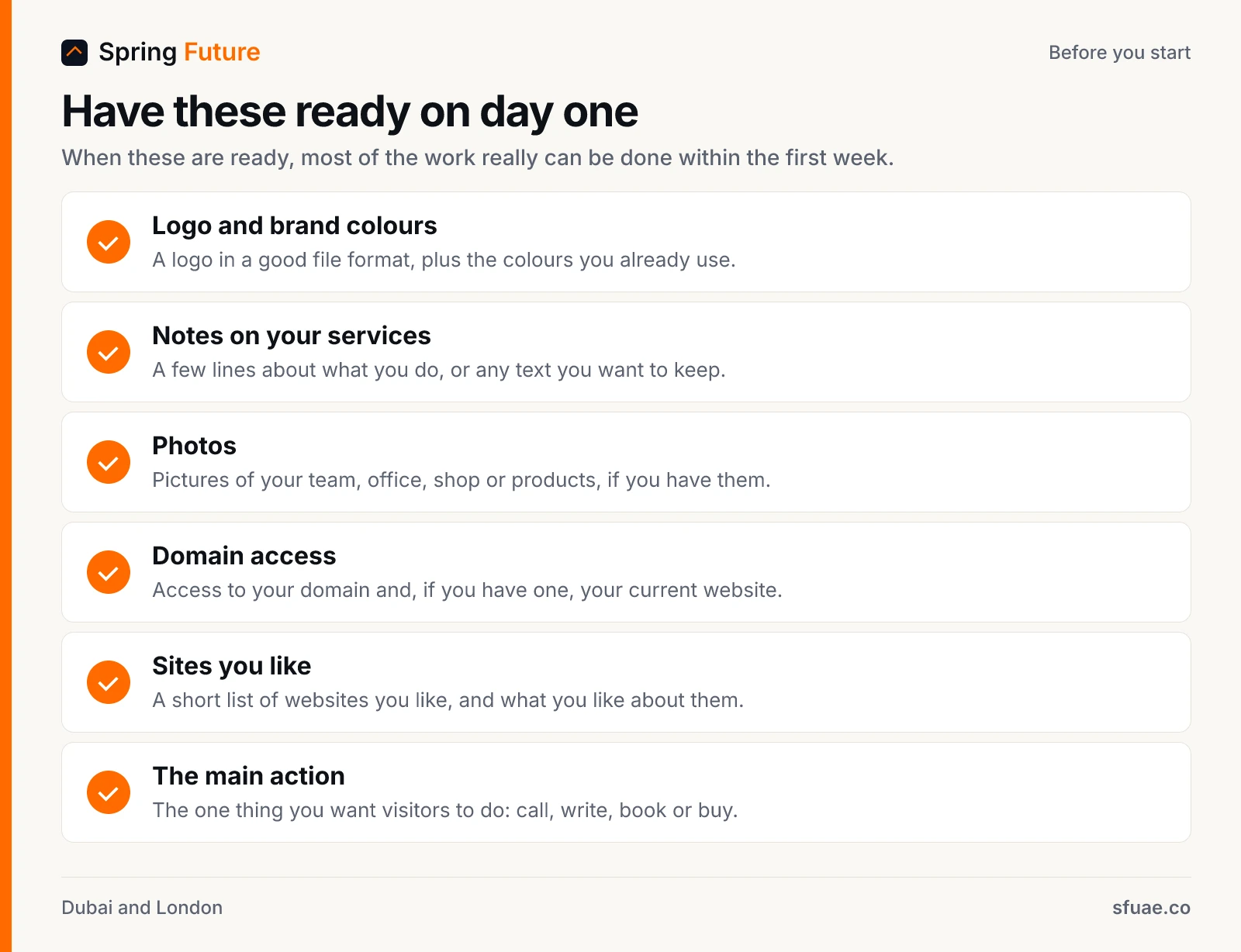
- Your logo and brand colours, if you have them
- Any text you want to keep, or a few notes about your services
- Photos of your team, office, shop or products
- Access to your domain and, if you have one, your current website
- A list of websites you like, and what you like about them
- The one main action you want visitors to take
With these ready on day one, most of the work really can be done within the first week.
Start your website
If you have a date in mind, tell us about it. Our team in Business Bay, Dubai, and in London will look at what your business needs and come back with a clear plan and timeline. See our website design work, or contact Spring Future and tell us about your business. We will take it from there.