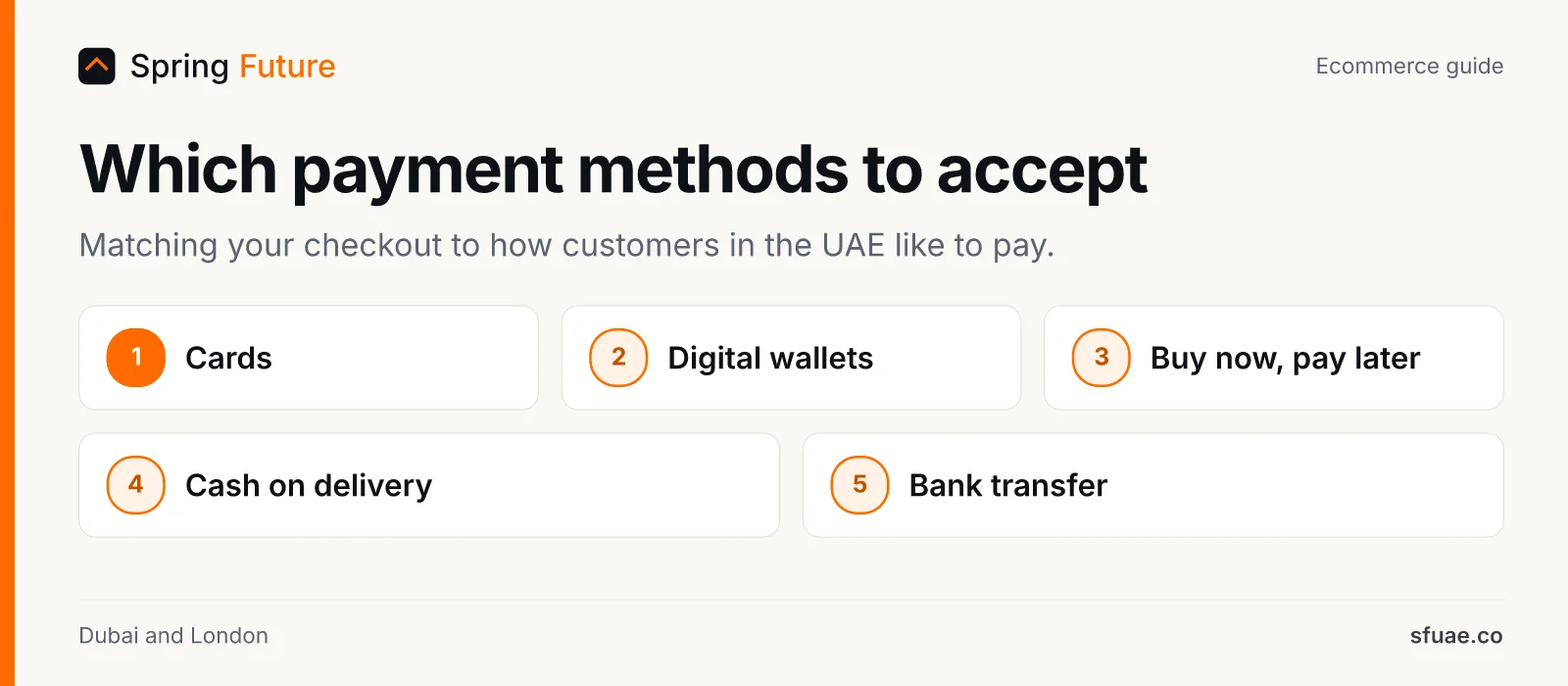

If you are planning an online store in the UAE, one question comes up early: which payment methods should you accept? Cards are the obvious start, but customers here also use Apple Pay and Google Pay, buy now pay later, cash on delivery and, for business orders, bank transfer. Offering the right mix makes checkout feel easy. Offering too few, or the wrong ones, can leave customers looking for another store.
The good news is that you do not need every method on day one. This guide explains what each payment method is good for, how to match them to your customers and products, how payment methods relate to payment gateways, and how to build a checkout that people trust. It is written by the team at Spring Future, a web design and ecommerce company in Dubai and London, and it works whichever platform you choose.
The short answer
For most online stores selling to customers in the UAE, a strong starting point is:
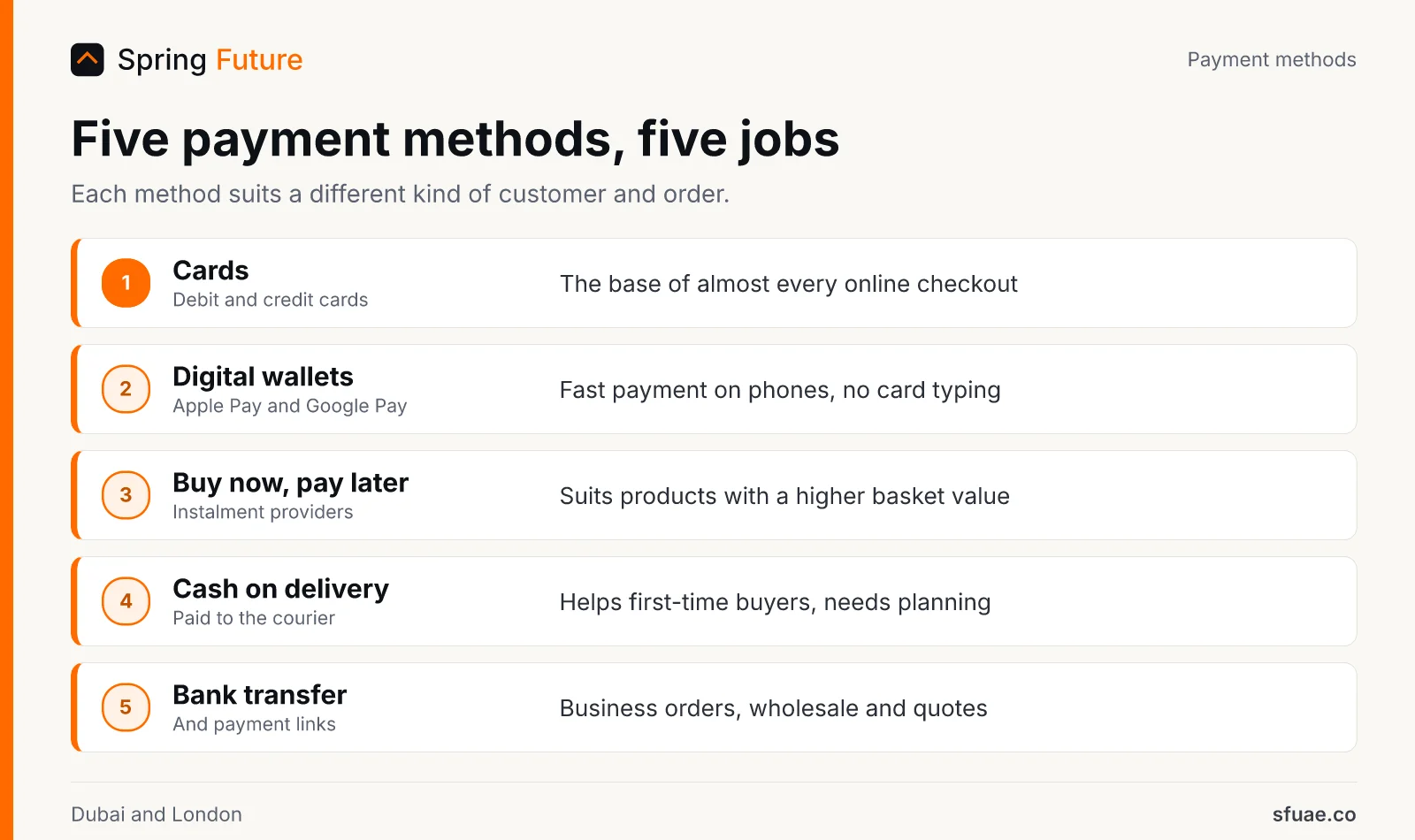
- Debit and credit cards — the base of almost every online checkout
- Apple Pay and Google Pay — quick payments on phones without typing card details
- Buy now, pay later — worth adding when your products have a higher basket value
- Cash on delivery — if your customers expect it and your delivery partner can handle it
- Bank transfer or payment links — for business customers, large orders and custom quotes
Show prices and totals in dirhams, keep the checkout short on phones, and test every method before you go live. The rest of this guide explains how to decide which of these your store really needs.
Start with your customers, not the payment list
The best payment mix depends on who buys from you and how they buy. Before you choose any provider, answer a few simple questions:
- Who are your customers? Individual shoppers, businesses, or both?
- Where are they? Mostly in the UAE, across the GCC, or around the world?
- What do they buy? Everyday items, higher-value products, services or bookings?
- How do they shop? Most visitors will reach your store on a phone, so the payment step must work well on a small screen.
- Is it their first order? New customers often want a payment method they already trust before they share card details with a store they do not know yet.
Write the answers down. They will guide every choice below, and they also make your conversations with payment providers and with your web team much clearer.
The main payment methods in the UAE
Debit and credit cards
Cards are the foundation of online payments in the UAE. Visa and Mastercard are widely used, and many customers are comfortable paying by card on a store they trust. Every payment gateway that serves UAE businesses supports card payments, so this is where your checkout starts.
Card payments online usually include an extra security step from the customer’s bank, such as a one-time code. That step protects both you and the customer, and a good checkout handles it smoothly, without sending the customer away and back in a confusing way.
Apple Pay and Google Pay
Digital wallets let customers pay with a saved card on their phone, confirmed with a fingerprint, face or code. On a phone, that means no typing of card numbers, which makes checkout faster and easier. Both Apple Pay and Google Pay are available in the UAE, and many card gateways can offer them as part of the same setup.
If most of your customers shop on phones — and for most stores they do — digital wallets are one of the simplest ways to make the payment step feel effortless.
Buy now, pay later
Buy now, pay later (BNPL) services, such as Tabby and Tamara in the UAE, let customers split a purchase into instalments. The store receives the payment from the provider, and the customer pays the provider over time according to its terms.
BNPL tends to suit products with a higher basket value, such as electronics, furniture, fashion, beauty and home goods. It can also help when customers want to buy now but prefer to spread the cost. Each provider has its own merchant approval, terms and fees, so speak to them early, before you fix your launch date.
Cash on delivery
Cash on delivery (COD) means the customer pays the courier when the order arrives. Some shoppers in the UAE still prefer it, especially for a first order from a new store. It removes the worry of paying in advance and can help new stores win their first customers.
COD also needs planning. Your delivery partner must be able to collect payment, you need to know when the money reaches you, and you need a clear process for orders that are refused at the door. Many stores offer COD only in certain areas or below a certain order value, and some add it later once they see what customers ask for.
Bank transfer and payment links
For business customers, wholesale orders and custom quotes, a bank transfer or a payment link is often the most natural option. A payment link is a secure page from your gateway that you can send by email, so the customer can pay a specific amount by card without going through the full store checkout.
If you sell to companies, or you agree prices by quote before an order, plan for this from the start. It keeps your sales process simple and your records tidy.
Match payment methods to your type of business
There is no single right answer for every store. The table below shows a sensible starting mix for common types of online business in the UAE. Treat it as a starting point, then adjust it to what your own customers ask for.
| Type of business | A sensible starting mix | Worth considering later |
|---|---|---|
| Everyday products | Cards, Apple Pay and Google Pay | Cash on delivery for first-time buyers in selected areas |
| Higher-value products | Cards, Apple Pay and Google Pay, buy now pay later | Cash on delivery with a clear order limit |
| Services and bookings | Cards, Apple Pay and Google Pay, with a deposit or full payment at booking | Payment links for custom packages |
| Business and wholesale | Bank transfer and payment links, plus cards for smaller orders | Account options for repeat business customers |
| Customers outside the UAE | Cards and digital wallets that accept international cards | Prices shown in more than one currency |
Payment methods and payment gateways are not the same thing
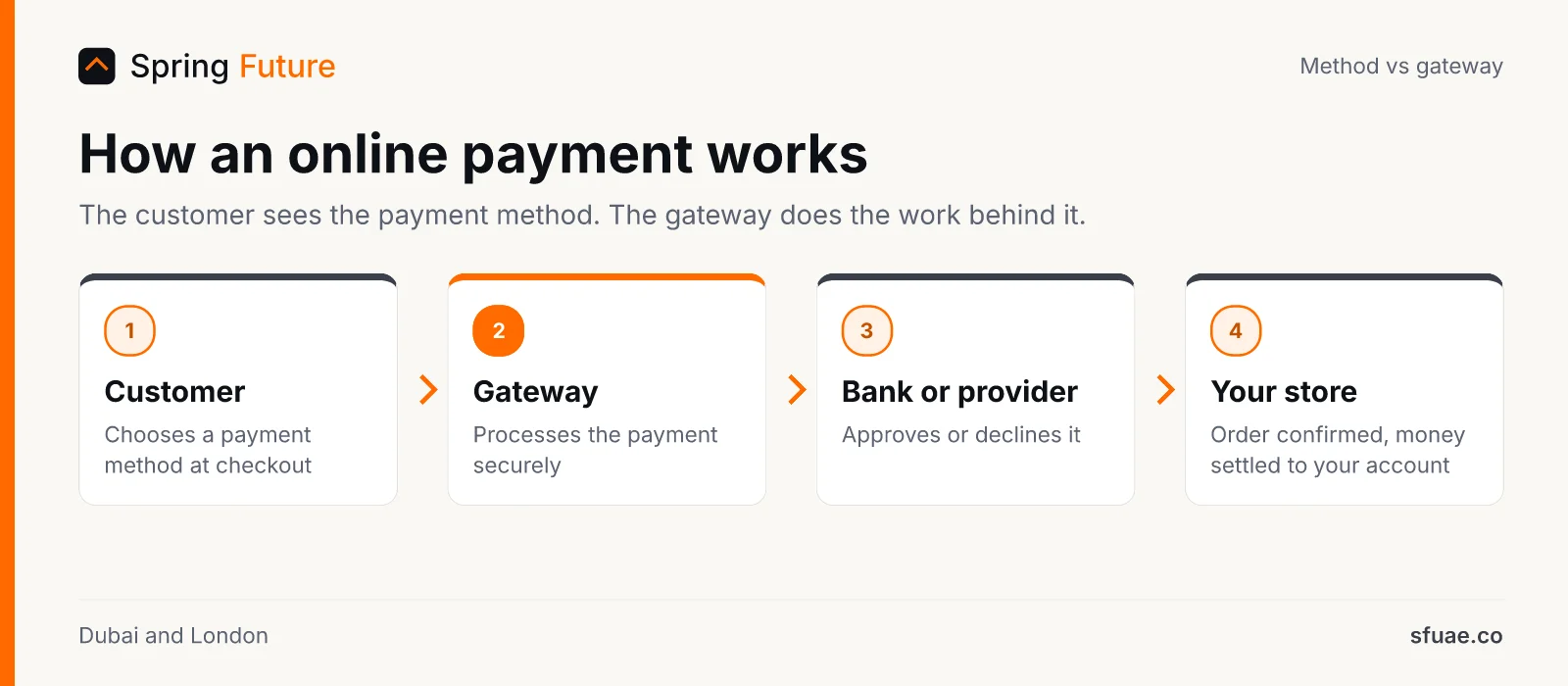
It helps to separate two ideas that often get mixed up. A payment method is how the customer pays: a card, a wallet, an instalment plan, or cash. A payment gateway is the service that sits between your store and the banks and card networks, processes the payment and sends the money to your account.
One gateway can offer several payment methods. For example, a card gateway may also give you Apple Pay and Google Pay, while buy now pay later usually comes from a separate provider with its own plugin or app. Cash on delivery is usually handled through your delivery partner and your store settings rather than a gateway.
So the usual order is: decide which payment methods your customers need, then choose the gateway or gateways that offer them on your platform. Our page on ecommerce payment gateways in the UAE explains the gateway side in more detail, including the common local and international options.
How your platform affects the choice
Your ecommerce platform decides how easily each payment method can be added. Shopify and WooCommerce both work with a wide range of payment providers through apps and plugins, and both can show cards, wallets and other methods at checkout. The difference is mostly in how each one is set up and maintained.
If you are still choosing a platform, it is worth checking that your preferred payment providers support it before you decide. Our comparison of Shopify and WooCommerce in Dubai covers how payments work on each, and our guide to the best ecommerce platforms in Dubai looks at the wider choice. For very large catalogues or complex B2B needs, Magento is another option with its own payment integrations.
Build a checkout that customers trust
The payment methods you offer are only part of the story. The way they appear at checkout matters just as much. A clear, calm checkout helps customers finish their order.
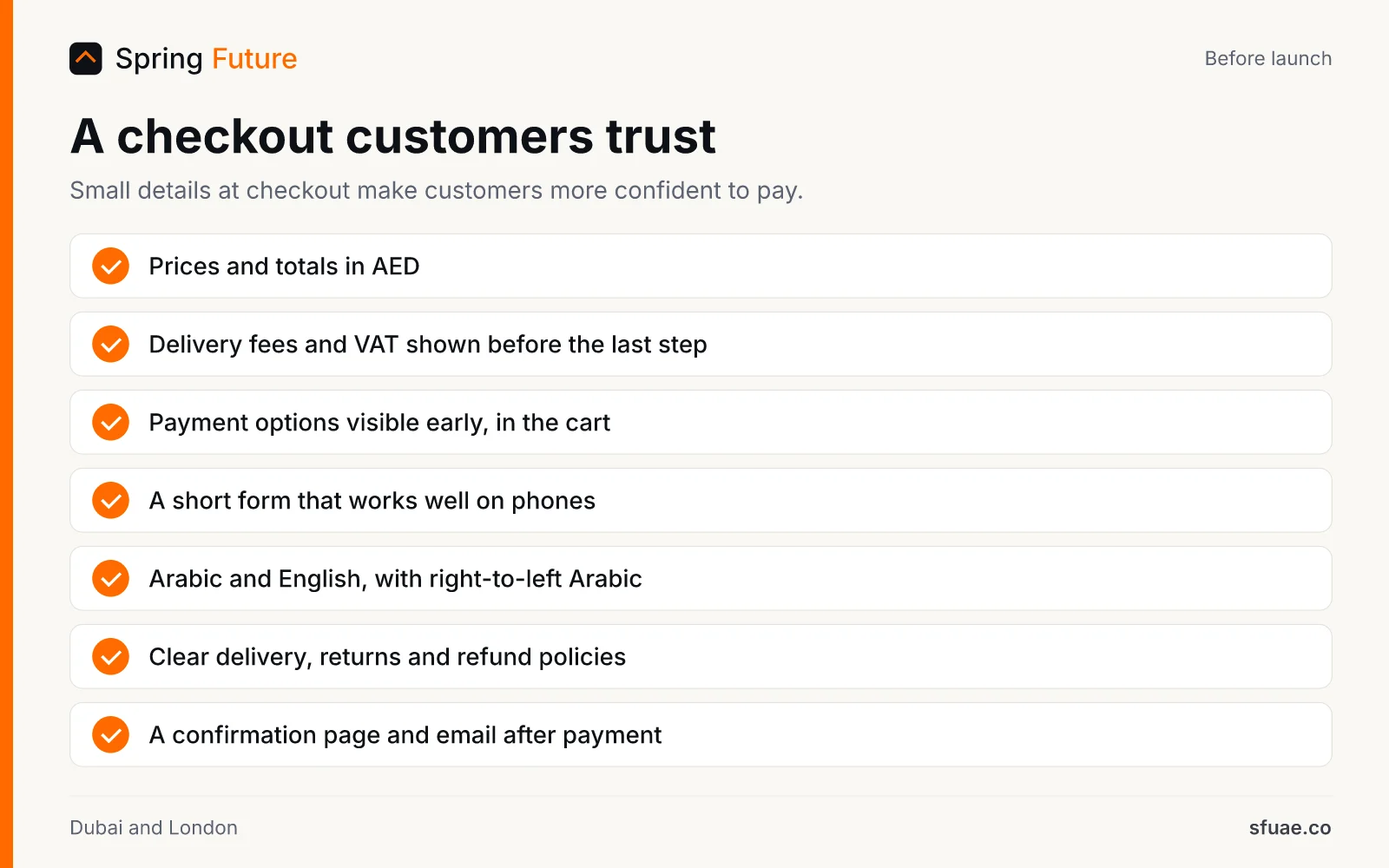
- Prices in dirhams. If your customers are mainly in the UAE, show prices and totals in AED.
- No surprises. Show delivery fees and VAT before the final step, so the total does not change at the last moment.
- Show payment options early. Customers like to know they can pay their preferred way before they fill in the whole form. Payment icons on product pages or in the cart help.
- Short and phone-friendly. Ask only for what you need, use large fields and buttons, and let the phone’s keyboard and autofill do the work.
- Arabic and English. If you serve both audiences, make sure the checkout, the payment step and the confirmation emails read well in both languages, with right-to-left layout for Arabic.
- Clear policies. Link to your delivery, returns and refund policies near the payment step.
- Confirmation. After payment, show a clear confirmation page and send an email with the order details.
Plan refunds and returns from the start
Every payment method has its own way of handling refunds. Card and wallet payments are usually refunded through the gateway, back to the same card. Buy now pay later refunds go through the provider, which then updates the customer’s instalments. Cash on delivery refunds need a separate method, such as a bank transfer or store credit.
Decide how each case works before launch and write it in plain language in your refund policy. Customers feel more confident when they can see how a return would work, and your team will know exactly what to do when a request arrives.
Test every payment method before launch
A payment method is only ready when it has been tested from start to finish. Before your store goes live, check each one:
- Place a test order with each payment method, on a phone and on a computer.
- Confirm that the order appears correctly in your store with the right payment status.
- Check that the customer receives the confirmation email in the right language.
- Make a test refund and confirm it shows correctly in the gateway and in the store.
- Switch the gateway from test mode to live mode, and place one small real order to be sure.
At Spring Future, we test a payment and a refund for every method before a store goes live. It is a small step that avoids awkward surprises on launch day.
Start simple, then grow
You do not need to launch with every payment method. Many stores start with cards plus Apple Pay and Google Pay, which already cover a large share of everyday online shopping. Once the store is live, listen to customers. If people ask for instalments, add buy now pay later. If first-time buyers hesitate, consider cash on delivery in selected areas. If businesses start ordering, add payment links or bank transfer.
Because each method is added through your platform’s settings, apps or plugins, this growth usually does not require a new website. It is one of the advantages of planning the store well from the start. If you are still at the planning stage, our guide to what shapes the cost of an ecommerce website in the UAE explains how payments fit into the wider project, and how long it takes to build a website helps you plan the timeline.
Questions to ask before you choose
Before you sign up with any provider, ask these questions. The answers will make your choice much clearer:
- Which payment methods do my customers expect?
- Does this provider work with my ecommerce platform?
- Which payment methods does it offer through one account?
- What documents does it need for merchant approval, and how long does approval usually take?
- How are refunds handled for each method?
- When does the money reach my bank account?
- Does the checkout work well on phones and in Arabic and English?
Setting up payments with Spring Future
We build online stores for businesses in the UAE, and payments are part of every project. You open the merchant account with the gateway you choose, so the account and the money stay in your business name. We connect it to your store, set up the payment methods your customers need, and test a payment and a refund before launch.
Our team works from Business Bay, Dubai, and from London. See our work on online store development in Dubai and ecommerce website development, or send us a short brief through the contact page. We will read it, suggest a payment mix that fits your customers and come back with a clear plan.